


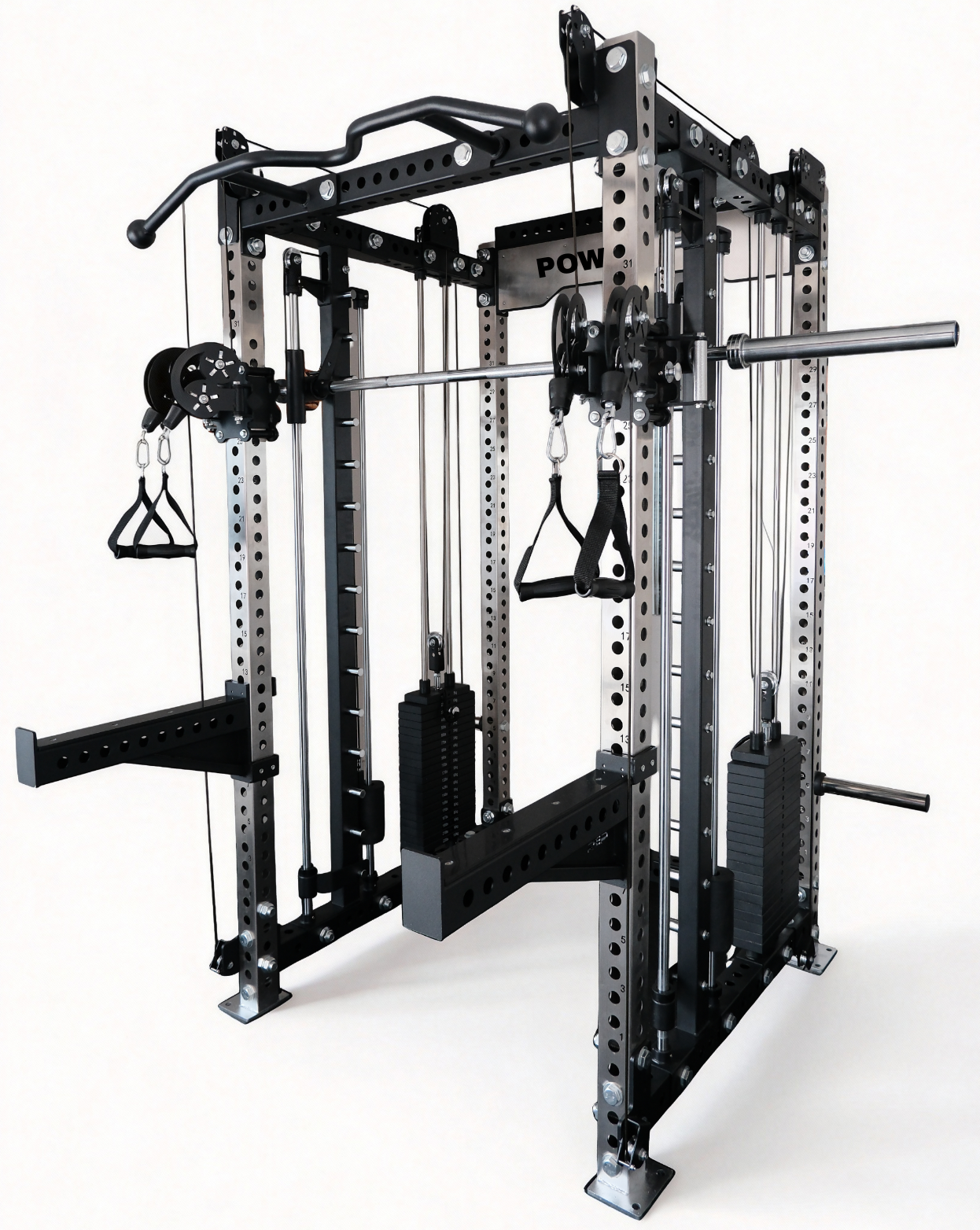

PowerBells Functional Trainer
Ultra-Smooth Cable Movement
Precision aluminium bearings and optimized cable routing ensure fluid, consistent resistance throughout every rep, even under heavy load.

PowerBells Functional Trainer
Premium Materials, Rock-Solid Construction
Built with smooth aluminum pulleys and a heavy-duty 75 × 75 mm, 3 mm-thick steel frame to deliver exceptional durability, stability, and a commercial-grade feel.

PowerBells Functional Trainer
Integrated Dual Weight Stack
Each side features a built-in weight stack starting at 70 kg and expandable up to 120 kg, eliminating plate loading while supporting serious strength progression.

Customise Your Way
Choose between below configurations for your cable machine in the custom rack:
- 2:1 Weight Ratio
- 1:1 Weight Ratio
- Or Double-Pulley System

Precision Smith Machine
Engineered with a high-strength steel guide system and smooth linear bearings, the Smith machine delivers stable, friction-free movement with the option to switch between a traditional vertical path or a slight tilt.
Frequently Asked Questions
What's a power cage actually for?
It's usually the centrepiece of a serious home gym, supporting squats, bench press, pull-ups, rack pulls, overhead press, and barbell rows. Most come with adjustable safety pins, which make solo lifting a lot safer.
How's a power cage different from a squat rack?
A power cage has four vertical posts forming a full enclosure, which is safer for lifting alone compared to a two-post squat rack. Squat racks take up less space but generally need a spotter for heavier attempts.
Does the cage need to be bolted to the floor?
For heavier lifters, or anyone doing pull-ups (which create sideways force on the frame), bolting it down is the safer option. Plenty of home gyms get by on the cage's own weight plus rubber matting, but it's worth checking the cage's stability before attempting max lifts.
Can the Power Cage be customised to suit a specific space or training style?
Yes, this is actually one of the bigger advantages of the Power Cage over a fixed-spec rack. The Smith machine can be set up as an incline or vertical, positioned at the front or back relative to the weight stacks, and the barbell comes in either the standard 2.2m length or a 1.8m space-saving option. The cable system can also be configured as 1:1, 2:1, or a dual pulley setup that switches between the two. Anyone working with a smaller space or a specific training focus is best to get in touch directly before ordering, since the team can talk through which configuration suits the room and the way it'll be used.